
Professional Garage Door Sensor Repair in Bradenton, FL
A door that won’t close, or one that closes and pops back open, usually points to a sensor problem. The fix is often simpler than homeowners expect. We repair and realign garage door sensors across Bradenton, most visits done in under an hour.
100+ ReviewS
Same-Day Service
Locally Owned & Operated
Why Your Garage Door Won’t Close
Most homeowners assume a broken door means a broken opener. Often, it is not the opener at all. Two small sensors sit near the bottom of the track, a few inches off the floor. They send an invisible beam across the doorway. If anything blocks that beam, the door will not close.
This is not a flaw. It is a safety feature built into every garage door made since the 1990s. The sensors stop the door from closing on a person, a pet, or a car.
Homeowners near Heritage Harbour and Palmetto often call us thinking their opener has failed. Most of the time, the fix is smaller than that.
Try This Before You Call Us
Before you book a repair, check these three things. Many sensor problems fix themselves in under five minutes.
Check for Anything Blocking the Sensors
Look at both sensors, one on each side of the track near the floor. A stored box, a bike, or a fallen leaf can block the beam between them. Move anything sitting in that path.
Wipe the Lenses Clean
Dust and pollen build up on the sensor lens over time. This is common in Bradenton, especially near landscaped yards along Manatee Avenue. Wipe each lens with a soft, dry cloth.
Look at the Indicator Light
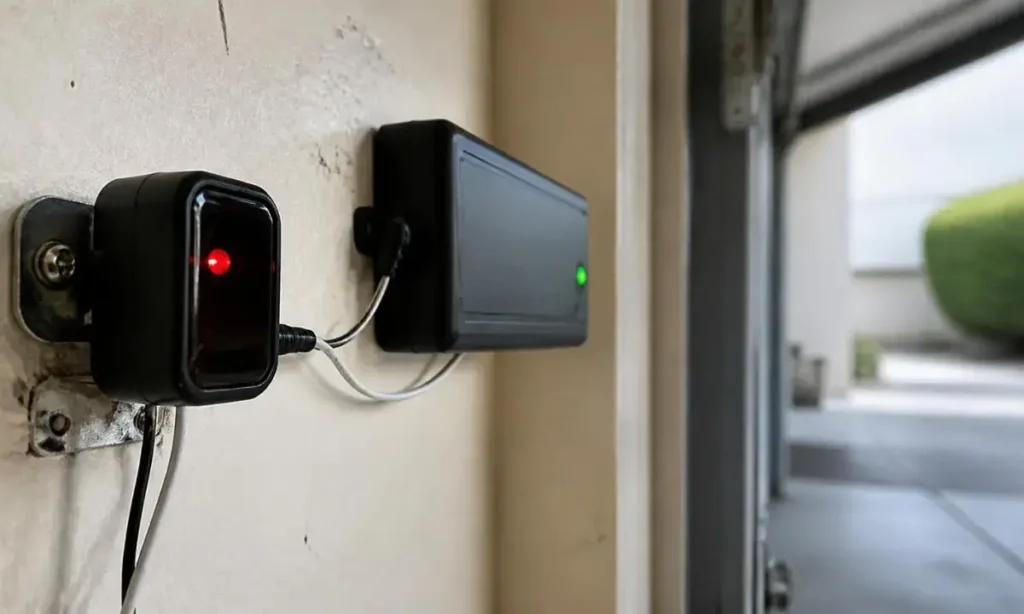
Most sensors have a small light on the side. A steady light means the sensors see each other. A blinking light means something is wrong. Note which sensor is blinking before you call.
If these steps do not fix it, the problem is likely alignment or wiring, not something you can fix by hand.
What the Blinking Light Is Actually Telling You
The blinking light is not random. It is the sensor telling you exactly what is wrong.
|
Light Pattern |
What It Means |
|---|---|
|
Steady light on both sensors |
Sensors are aligned and working |
|
One light off completely |
That sensor has no power or a wiring break |
|
Both lights blinking |
Sensors are misaligned or blocked |
|
Light flickers when the door moves |
Loose wire, often from vibration over time |
|
No light on either sensor |
Power issue at the opener or a cut wire |
A steady light on both sides is what you want to see. Anything else means the safety circuit is interrupted, and the opener will not let the door close. We check this light first on every visit. It tells us where to start before we touch a single wire.
What Makes a Garage Door Sensor Reliable
Infrared photo-eye sensors are the standard on nearly every modern opener, and for good reason. They react instantly, work in nearly any light condition when installed correctly, and meet UL 325 requirements out of the box. Some newer smart openers pair sensors with backup battery systems, which matters more in Bradenton than most places, given how often storms knock out power mid-cycle.
Common Reasons Garage Door Sensors Fail in Bradenton
Bradenton’s sun, storms, and salt air all play a part in sensor failure. Here are the three causes we see most often.
Sun Glare and Sensor Alignment
Florida’s low afternoon sun shines straight into west-facing garages. Strong sunlight can overpower a sensor’s beam, almost like blocking it. Homes near Cortez Road with west-facing doors see this often. A sensor that has been bumped even slightly makes the glare problem worse.
Storm Damage and Power Surges
Bradenton’s summer storms bring frequent lightning strikes. A power surge can fry a sensor’s internal circuit in an instant. Wind can also knock a sensor bracket out of alignment. Heavy rain sometimes works its way into loose wiring connections.
Corrosion in the Wiring
Salt air and humidity do not just wear down cables and springs. They affect sensor wiring too. A corroded wire connection causes a weak or broken signal. This shows up more often in homes near the Manatee River, and a corroded connection can look fine until we actually test it.
When Realignment Is Enough, and When You Need a New Sensor
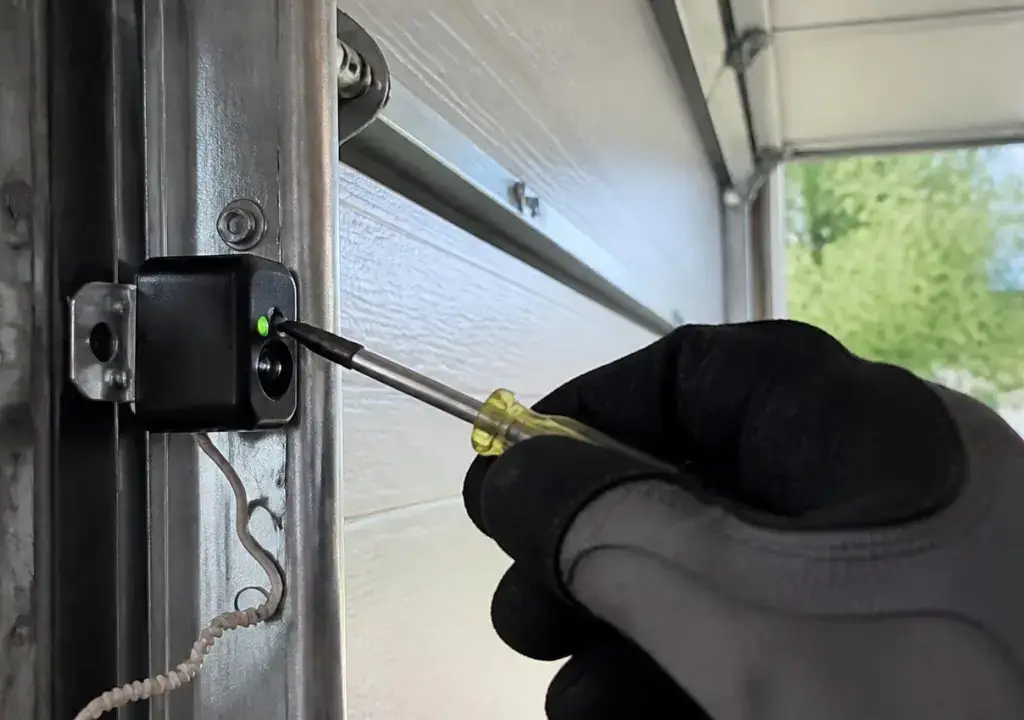
Most sensor problems do not need a new part. Realignment fixes the majority of calls we get. If the sensor still lights up but the beam keeps breaking, realignment is usually enough. We loosen the bracket, aim both sensors at each other, and lock them back in place. The fix takes a few minutes and costs far less than a new unit.
A new sensor becomes necessary when the light does not come on at all, even with a full power supply confirmed. A cracked lens, a fried circuit board, or wiring damaged beyond repair also means replacement. Pushing a broken sensor back into place will not fix a part that has actually failed.
We test both before we recommend either one. We do not sell a new sensor when a five-minute adjustment will do the job.
The same honest approach applies across the door. If something else is grinding or sticking, see our roller repair page for the same kind of fix-first advice.
How We Diagnose and Fix a Garage Door Sensor
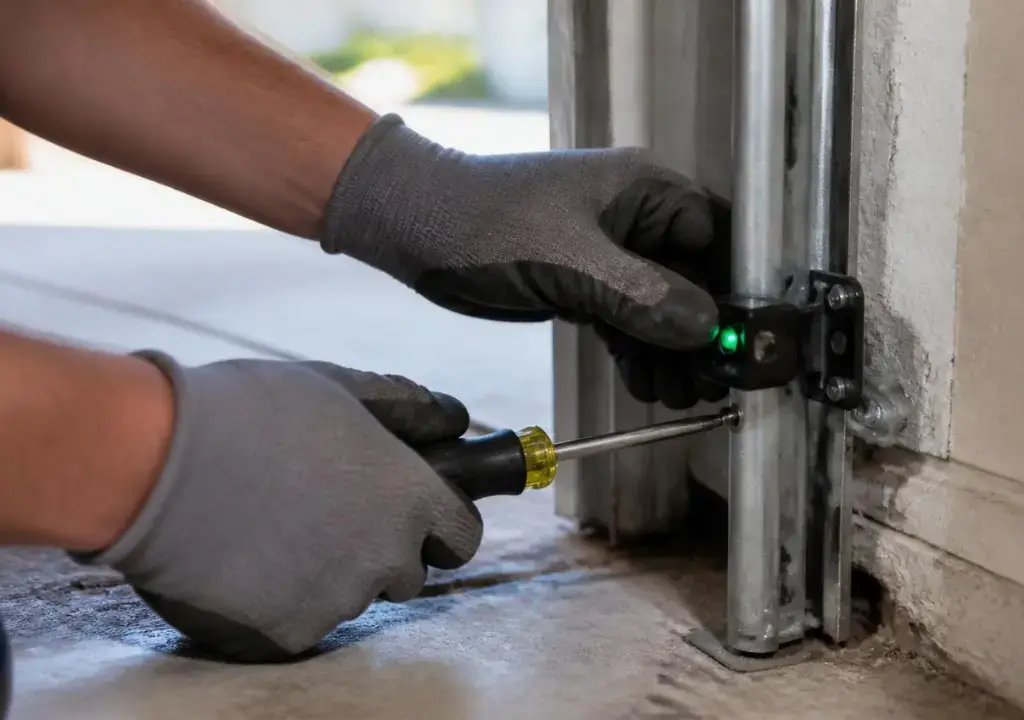
We follow the same steps on every call. This keeps the fix accurate, not a guess.
🔍 Power and Light Check
We confirm both sensors have power and check the indicator light on each one. This tells us if the issue is electrical or physical.
📏 Alignment Test
We check the beam path between both sensors for anything blocking it, then test their angle against each other.
🔧 Wiring Inspection
We trace the wiring back to the opener, checking for corrosion, loose connections, or storm damage along the way.
✅ Full Cycle Test
We run the door through several open and close cycles, confirming the sensors stop the door correctly every time before we call the job done.
Garage Door Sensor Repair Cost in Bradenton, FL
|
Service |
Typical Price Range |
|---|---|
|
Sensor realignment |
$80 to $130 |
|
Wiring repair |
$100 to $200 |
|
Full sensor replacement (one or both) |
$150 to $300 |
We give you one firm price after we test the system in person. No per-part surprise once the visit starts.
Why Federal Law Requires These Sensors
Garage door sensors are not optional. Federal law has required them since 1993.
Congress passed the Consumer Product Safety Improvement Act in 1990. It set a deadline. Every residential garage door opener made after January 1, 1993, had to include entrapment protection. In most doors, that means the two sensors near the floor.
The safety standard behind this law is called UL 325. It sets the rules for how these sensors must work, including how small an object they need to detect. A garage door without working sensors is not just risky. It fails a federal safety requirement.
This is why we never suggest bypassing a broken sensor. A door that closes without sensor protection can close on a child, a pet, or a car bumper. The law exists because that used to happen more often than anyone wants to think about.
If your home has an opener from before 1993, it likely predates this rule entirely. We can tell you during an inspection, and talk through an upgrade if needed.
Why Bradenton Homeowners Trust Us for Sensor Repair
Sensor problems get misdiagnosed often. A good tech checks before guessing, not after.
Areas We Cover for Sensor Repair
We repair garage door sensors across Bradenton and the rest of Manatee County. Our coverage includes:
Palma Sola, West Bradenton, East Bradenton, Downtown Bradenton, Bayshore Gardens, Village of the Arts, Heritage Harbour, Lakewood Ranch, Palmetto, Ellenton, and Parrish.
If your neighborhood is not listed, call us. Most sensor repairs still get scheduled the same day, no matter where you are in the county.
Got Questions?
We’re happy to help. If you can’t find the info you’re looking for, please don’t hesitate to reach out to us!
Garage door sensors acting up in Bradenton? Let’s get it seeing straight.
We’ve been locally based and hurricane-season tested since 2017, licensed and insured, and ready with same-day sensor repair across every Bradenton neighborhood.
We stand behind our work: 1-Year Labor Warranty — if the same sensor issue comes back on work we completed, we fix it again at no charge. No fine print, no exceptions.